10Product Strategy
Decide well before it's expensive.
Discovery sprints, roadmaps and honest technical advice — a week of thinking that routinely saves a quarter of building the wrong thing.
What we do
Most product failures are decided before the first commit: wrong problem, wrong scope, wrong first version. Strategy work is where we argue those out cheaply — with research, user conversations and prototypes measured in days. The output is never a 60-page deck; it's a decision.
We also sit on your side of the table for the technical calls: which stack, which vendor, build-vs-buy, "is this estimate sane?". Advice from people who also build means we recommend what we'd be willing to ship ourselves.
What you get
- Discovery sprints
- A focused 1–2 weeks: problem, users, constraints, and a testable direction.
- Product roadmaps
- Sequenced, honest roadmaps — what to build, what to skip, what to fake first.
- Workshops
- Positioning, naming, feature triage — facilitated so decisions actually happen.
- Technical advisory
- Stack choices, vendor reviews and estimate sanity-checks from working builders.
- MVP scoping
- The smallest version that teaches you the most, defined precisely.
- Metrics & experiments
- What to measure, how to test it, and when to change your mind.
How it runs
- 01
Frame
We name the real problem and the riskiest assumption — usually not the one you came in with.
- 02
Test cheap
Prototypes, interviews and landing tests before anything expensive gets built.
- 03
Commit
A roadmap with reasons. Then, if you want, the same team builds it.
We build it with
- FigJam
- Notion
- Linear
- Maze
- Amplitude
- Sheets
Proof you can use.
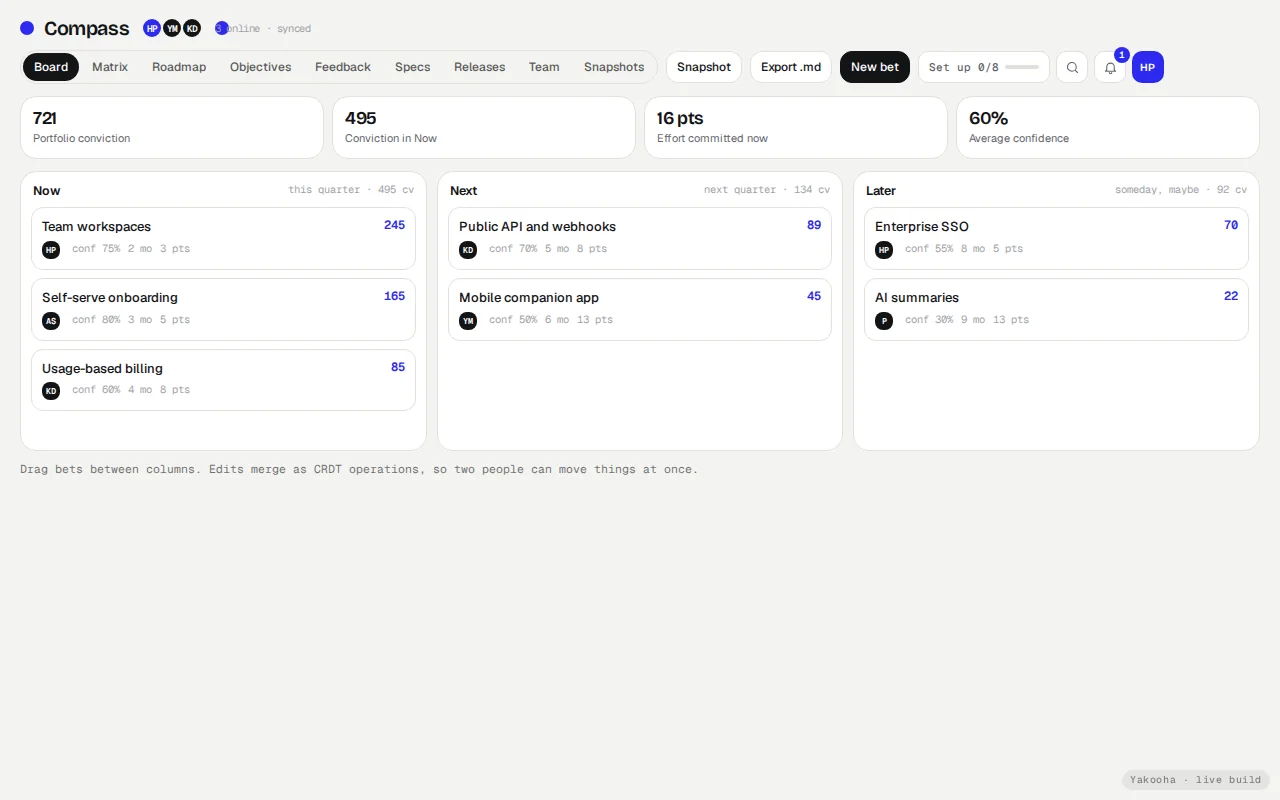
Products we built under this service. Each one runs inside its case study.
Questions we get
Is strategy only for new products?
No — half of it is rescuing existing ones: stalled roadmaps, feature bloat, "users churn and we don't know why". Fresh eyes plus data.
What does a discovery sprint actually produce?
A written point of view: the problem, the users, the riskiest assumptions, a scoped v1 and a plan to test it — short enough to be read, sharp enough to act on.
Do we have to build with you afterwards?
Not at all. The strategy stands on its own — though most people stay, because the folks who planned it are annoyingly good at building it.